The Halo Effect in UX: Why First Impressions Last in Design
Learn how the Halo Effect influences user perception. Discover how visual design and strong "wow" moments can elevate your entire product experience.

First Impressions Last: Leveraging the Halo Effect in UX Design
Have you ever met someone for the first time and immediately thought they were intelligent or trustworthy just because they were well-dressed or articulate? Or perhaps you’ve visited a website with a stunning landing page and instantly assumed the product itself must be world-class and secure?
If so, you’ve experienced the Halo Effect.
In the world of User Experience (UX) and digital product design, the Halo Effect is one of the most powerful psychological tools at your disposal. It is a cognitive bias where our overall impression of a person, brand, or product influences how we feel and think about their character or properties in other areas. In design, a positive "halo" created by a beautiful interface or a seamless onboarding flow can illuminate the rest of the user journey, making users more patient, more trusting, and more likely to convert.
In this guide, we will explore how to harness the Halo Effect to build immediate credibility and long-term user loyalty.
What Is the Halo Effect?
The Halo Effect is a type of cognitive bias where our perception of one specific trait (like physical beauty) influences our perception of other, unrelated traits (like intelligence or kindness). It was first coined by psychologist Edward Thorndike, who noticed that officers in the military tended to rank subordinates high in all categories if they were physically fit and had a good posture.
In a digital context, this means that if a user finds your website visually appealing, they are statistically more likely to believe it is also easy to use, secure, and high-quality—even before they’ve clicked a single button.
"We tend to judge a book by its cover, and this initial assessment often colors our entire reading." — Adaptation of Edward Thorndike's concept
Essentially, our brains use mental shortcuts to form judgments quickly. Evaluating every single feature of a software product takes significant cognitive effort. Instead, we use our "overall impression" as a guide. If the "cover" is good, we assume the content is too.
Why the Halo Effect Matters for Your Product
The impact of the Halo Effect on business metrics and user satisfaction cannot be overstated. It directly affects how users interact with your interface and how they perceive your brand’s value.
- Increased Forgiveness (The Aesthetic-Usability Effect): Research shows that users are more tolerant of minor usability issues or slow loading times if the interface is visually pleasing. The "halo" of good design masks small flaws that might otherwise lead to frustration and churn.
- Higher Perceived Value: Products that look "premium" are perceived as being more valuable. This allows companies to command higher price points and reduces price sensitivity among users.
- Instant Trust and Credibility: In an era of phishing and digital scams, trust is the primary currency. A polished, professional look signals that your company is legitimate and cares about its reputation.
- Reduced Cognitive Load: When a user's first impression is positive, they enter a state of "positive affect." This mental state makes it easier for them to navigate the site and process information, leading to higher engagement rates.
See which persuasion techniques your site is missing
Analyze your conversion triggers and find untapped psychological opportunities in your interface.
Scan Your Site FreeHow to Implement the Halo Effect in Your Design
Creating a "halo" requires strategic focus on the areas of your product that users encounter first or most frequently. Here is how to implement this principle effectively.
1. Nail the First Impression
The first few seconds a user spends on your site are the most critical. This is where the halo is formed.
- Invest in Visual Polish: High-quality typography, professional imagery, and a cohesive color palette are not "surface-level" details—they are the foundation of trust.
- Smooth Onboarding: Ensure the very first flow a user experiences—whether it's a sign-up or a tutorial—is frictionless.
- ✅ Do this: Use high-resolution, original photography and a clear hierarchy.
- ❌ Avoid this: Using generic, low-quality stock photos or cluttered layouts that overwhelm the user immediately.
2. Highlight Your "Flagship" Feature Early
Don't hide your best work deep in the navigation. Present your most impressive functionality or your clearest benefit at the very beginning of the user journey.
- The "Wow" Moment: Identify the core value proposition of your product and lead with it. If your app has a beautiful data visualization tool, show it on the dashboard immediately.
- Lasting Impression: An initial success or "wow" moment creates a lasting halo that keeps the user motivated through more mundane tasks like filling out profile details.
3. Associate with Trusted Brands or People
The Halo Effect can be "transferred" from a known entity to your product. This is why testimonials and partnerships are so effective.
- Leverage Authority: If industry leaders use your tool, display their logos prominently. This transfers the trust users have in those brands to your product.
- Social Validation: Customer success stories and reviews provide a "social halo."
- Related Reading: See The Power of Social Proof and The Voice of Authority Bias.
4. Take Care of Fundamental Usability
While aesthetics create the halo, actual functionality sustains it.
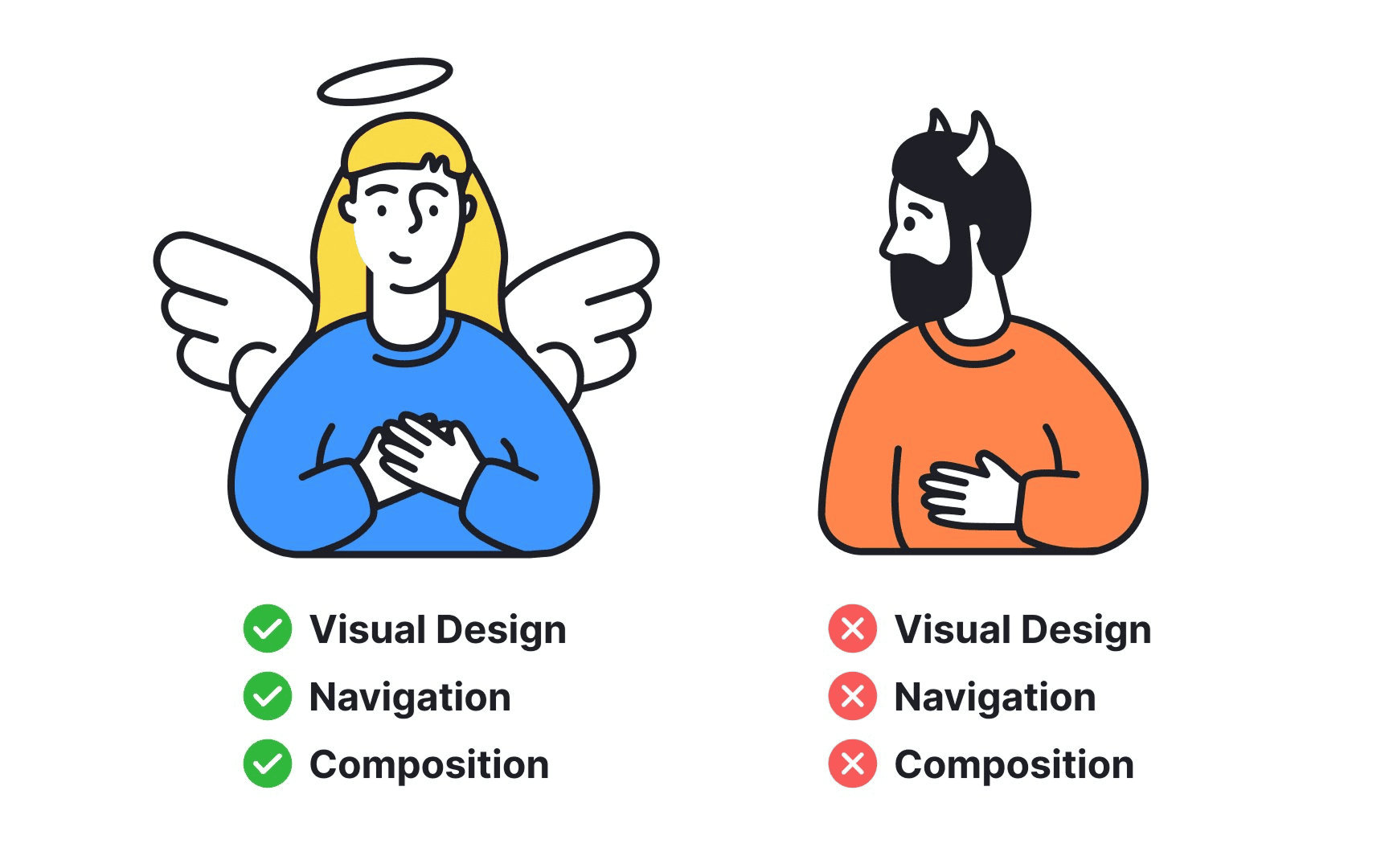
- Don't Break the Spell: A beautiful design that is frustrating to use will eventually cause "cognitive dissonance." Once the user realizes the product doesn't work, the halo shatters, often leading to a "Horn Effect" (the opposite of a halo), where the user becomes hyper-critical of everything.
- Performance Matters: A beautiful site that takes 10 seconds to load loses its halo before it even renders.
Common Halo Effect Mistakes to Avoid
1. The "Veneer" Trap
- The problem: Using a beautiful UI to hide serious functionality, security, or privacy issues.
- The fix: Ensure your engineering and security are as polished as your pixels. The halo should reflect genuine quality, not act as a mask for deception.
2. Inconsistency Across the Journey
- The problem: Having a stunning landing page but a "broken" or ugly inner app experience.
- The fix: Maintain design consistency. If the experience degrades significantly after the user signs up, they will feel "tricked," destroying the trust you built.
3. Over-Reliance on Trends
- The problem: Following design trends that look "modern" today but might feel dated or unprofessional to your specific target audience.
- The fix: Design for your user's expectations of "quality," not just what's trending on Dribbble.
The Halo Effect in Action: Real Examples
Apple

Apple is the ultimate master of the Halo Effect. Their focus on sleek industrial design, premium packaging, and minimalist retail stores creates a powerful positive halo. Because the iPhone looks and feels like a high-end luxury object, users automatically perceive Apple’s software as more intuitive, innovative, and secure. Even when Apple removes features (like the headphone jack) or releases software with bugs, the strength of their "brand halo" ensures that loyal users remain tolerant and continue to perceive the brand as the gold standard of technology.
Stripe
Stripe transformed the world of payment processing—not just through its API, but through its design. By creating the most beautiful and well-documented developer experience in the industry, they created a halo of "simplicity" and "reliability." Developers assumed that because the documentation was so clean and the dashboard so elegant, the underlying financial infrastructure must be the most robust on the planet.
See how your site compares
Our AI analyzes your interface against the same principles used by Apple and Stripe.
Get Your Free UX ScoreRelated UX Principles
The Halo Effect doesn't work in isolation. It is often bolstered by other psychological triggers that influence how users "connect" with a brand.
Social Proof
How the actions and approvals of others influence our own decisions.
Authority Bias
The tendency to attribute greater accuracy to the opinion of an authority figure.
Resources & Further Reading
The Halo Effect in Psychology: Definition and Examples
Explanation of Thorndike's original concept and modern examples.
Why do positive impressions influence our opinions?
Deep dive into the Decision Lab's analysis of the bias and its impact on marketing.
Frequently Asked Questions
Don't Guess Your UX. Scan It.
Upload your screens or paste your URL to get expert-level UX analysis in under 3 minutes.
Start Free ScanRelated Articles
The Confirmation Bias in UX: Aligning Design with User Beliefs
Learn how confirmation bias influences user behavior and how to use it in UX design to build trust, reduce friction, and increase conversion rates.
Anchoring Bias in UX: How First Impressions Shape Value Perception
Master the anchoring bias in UX design. Learn how to use initial information to guide user perception of price, value, and task complexity for higher conversions.
Authority Bias in UX: Using the Voice of Authority to Drive Conversion
Learn how Authority Bias influences user behavior. Discover how to use expert endorsements, credentials, and trust signals to increase conversions and credibility.